

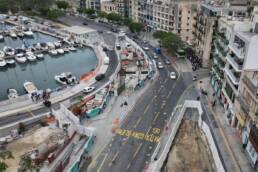
Friends of the Earth Malta, Moviment Graffitti and Rota strongly condemn the recent proposal to build a pedestrian bridge as part of the Msida Creek project. The NGOs noted that similar proposals to build pedestrian bridges as part of the original plans for the project in 2020 had been shot down for a multitude of reasons.
A bridge at the proposed location would not be designed with pedestrians’ safety and convenience in mind but would simply be there to improve traffic flow. Rather than crossing the road quickly and safely using pelican lights as has always been the case, pedestrians would now have to take a longer route, going up multiple stories or ramps, or relying on elevators that are often not working. A reporting system developed by Rota received over 350 out of order lift reports in the span of just 2.5 years. This takes into account only people who reported the damage, the actual number is therefore likely much higher.
Safety is another big concern. Considering the crossing is right across the busy Kulleġġ bus stop, while also acting as a connection between the two sides of Msida, a bridge there would pose a safety hazard, not a safety measure. It is not inconceivable for pedestrians to attempt crossing underneath the bridge, despite the risks of doing so. Furthermore, crossing a pedestrian bridge at night would not add to a feeling of safety for anyone trying to cross, and is likely to motivate pedestrians close by to use private vehicles instead.
Furthermore such a bridge would not be inclusive of elderly persons, people with mobility issues, cyclists, those carrying items or those with pushchairs. Similar bridges erected elsewhere in Malta – with the notable exception of the one at Blata il-Bajda – remain underutilised. Cyclists travelling from Valletta who would like to cross towards the Junior College area will have to depend on elevators rather than a simple level crossing, as will the many people with reduced mobility or with pushchairs using the crossing on a daily basis.
There is a glaring lack of transparency as to why the bridge was proposed without consultation and was imposed on the communities, after it had already been shot down six years ago. The Government claims Junior College students proposed the bridge, however, no consideration was given to residents and other commuters in that area, nor to transport experts. The Msida Local council noted that a bridge will cause a big inconvenience to residents.
The obvious alternative to a bridge is a level crossing with pelican lights whereby people would congregate and all cross at one go. Busy pedestrian crossings are designed to move large numbers of people quickly and safely: Shibuya Crossing in Tokyo allows 3,000 people to pass in under a minute, Times Square in New York around 1,200 in 30–40 seconds, and Oxford Circus in London about 800 people in roughly 40 seconds. If the same number of people had to cross using a lift that fits only six people at a time, it would take between one and four hours to move everyone across, even under unrealistically ideal conditions. This comparison highlights that
If the Government is serious about making mobility inclusive, safe and accessible, they would ensure that connectivity for pedestrians and cyclists is prioritised across all major infrastructural projects.
As NGOs representing citizens we demand infrastructure that addresses the present and future needs of everyone – from young to old, on foot or by bicycle – not just vehicles, and solutions which do not just circle back to the same tired ideas.